

Mobile Cranes for Heavy Equipment Installations

- June 25, 2026
Matching Crane Type to Site and Load Requirements
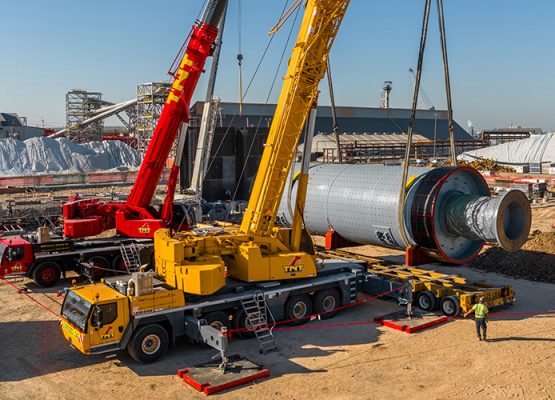
When a refinery needs a new compressor set, a power plant is dropping in a transformer, or a manufacturing facility is installing a press line, the crane selection decision shapes the entire project schedule. At TNT Crane & Rigging, we work through these scenarios daily, and the right mobile crane configuration for heavy equipment installations is rarely the most obvious one on paper.
Three crane categories cover most heavy equipment installation work:
- + All-terrain cranes are highway-mobile and handle frequent repositioning between sites. They deliver high lift capacity with faster mobilization on paved industrial surfaces.
- + Rough-terrain cranes are purpose-built for congested facilities and unimproved surfaces. Faster rig-up times make them efficient for short-duration lifts in tight industrial environments.
- + Crawler cranes distribute load across a track footprint, making them the right call when ground bearing pressure is a constraint or when a lift extends over multiple days.
The real decision driver is how capacity interacts with your site access, ground conditions, and overhead obstructions.
+ Learn more about the different types of mobile cranes and their applications
What the Capacity Charts Don’t Show You
Lift planning goes beyond matching rated tonnage to equipment weight. A crane’s capacity drops significantly as working radius increases, so the actual pick point relative to the crane’s center pin determines what the machine can realistically handle. Rigging hardware (slings, spreader bars, lifting beams) adds to the total load, and outrigger loads on soft or compromised ground can require matting systems or a full switch to crawler configuration.
Industrial facilities add another layer: overhead piping, electrical infrastructure, and operating clearances often eliminate crane configurations before capacity is even evaluated.
Why In-House Engineering Accelerates Your Critical Path
Most project delays in heavy equipment installations don’t come from the crane. They come from the coordination gap between the crane provider, third-party rigging engineers, and the general contractor. When those functions are separated, every revision cycle costs schedule time.
Our in-house engineering support integrates lift planning, rigging design, and equipment selection under one roof. Critical lift plans covering load distribution, rigging configurations, and clearance verification move faster when engineers and operators work together from the start.
When Mobile Cranes Aren’t Enough
Some installations require more than a single crane working alone. Gantry systems and SPMTs handle ultra-heavy loads or confined indoor placements where boom clearance is unavailable. Jack-and-slide systems move equipment through tight spaces inside operating facilities. For final precision placement of turbines, transformers, and compressors, machinery skates and cantilever rigging are often the right call. Knowing when to combine methods is as important as knowing which crane to send.
Plan for Equipment Availability, Not Just Equipment Specs
Peak construction seasons create real equipment shortages. A single-location provider running lean may subcontract during a crunch, introducing coordination delays exactly when your project can’t absorb them. Our fleet depth and regional branch network exist to give industrial projects a reliable buffer against that risk.
Heavy equipment installations demand more than horsepower on a spec sheet. When your project requires the right crane, the right rigging plan, and the capacity to deliver both without delays, connect with our team at 1-800-799-2505 to work through your lift requirements.
Related Blogs
- June 18, 2025
Types of Mobile Cranes and Their.
What are the Different Types of Mobile Cranes? Every lifting project comes with its own set.
- September 9, 2025
Mobile Crane Standards and Regulations
Why Mobile Crane Standards and Regulations are Important Following mobile crane standards and regulations is essential.