

How Lift Plans Are Created
- July 14, 2026
Understanding How Lift Plans Are Created
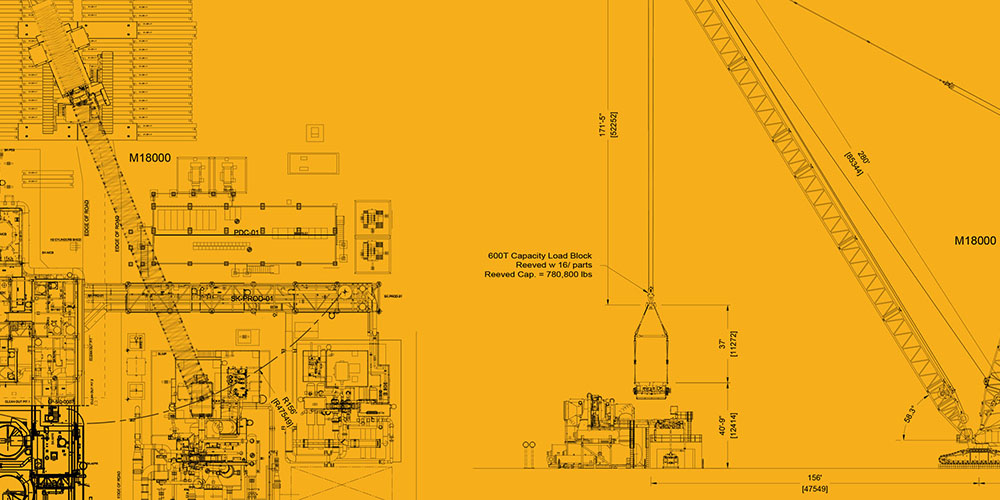
Every crane lift starts with a plan, and the quality of that plan directly determines how safely and efficiently the work gets done. At TNT Crane & Rigging, our in-house team of professional engineers produces detailed, accurate critical lift plans and rigging diagrams before any piece of equipment moves. Understanding how lift plans are created helps project managers, general contractors, and site supervisors coordinate more effectively, provide the right information upfront, and set realistic timelines for project execution.
Phase 1: Site Assessment and Information Gathering
Lift planning is a collaborative process from the start. Our engineers need accurate project data before any calculations can begin, which means working closely with the client to build a complete picture of the lift environment.
The core information we collect includes:
- + Load details: weight, dimensions, and center of gravity
- + Site conditions: ground bearing capacity, overhead obstructions, underground utilities, and proximity to existing structures
- + Access and positioning: crane mobilization routes, set-up zones, and any site restrictions that affect placement
- + Project timeline: sequencing requirements that influence equipment selection and staging
Incomplete or inaccurate information at this stage is one of the most common sources of lift plan problems. Our engineers bring 41 years of field experience to this phase. We know what to ask and what to look for, including site constraints that aren’t always obvious from drawings alone.
Phase 2: Crane Selection and Configuration
With site data in hand, our engineering team determines the right equipment for the job. This is where fleet depth matters. With more than 750 cranes across multiple crane types, our engineers can match the right equipment to the project’s specific demands rather than work around what happens to be available.
Selection criteria include:
- + Crane type and capacity: matched to load weight and configuration
- + Boom length and configuration: determined by lift height, radius, and clearance requirements
- + Counterweight requirements: calculated to achieve safe lift parameters within manufacturer load charts
- + Ground bearing capacity: factored against outrigger footprint and crane weight
For complex lifts, our team also assesses whether specialized rigging equipment, such as gantry systems, jack and slide systems, or SPMTs, is required alongside or instead of a conventional crane.
+ Find out which type of mobile crane will work best for your project
Phase 3: Engineering Calculations and Documentation
This is where the formal lift plan takes shape. Our engineers calculate load radius, crane capacity at that radius, rigging loads, and sling angles. Those calculations are then translated into detailed documentation covering:
- + Crane positioning and orientation onsite
- + Load path and swing radius with clearance measurements
- + Rigging configuration, sling types, and attachment points
- + Emergency procedures and communication protocols
- + Personnel assignments and role definitions
For critical lifts approaching capacity thresholds or involving unusual complexity, the documentation is more rigorous and undergoes additional internal review. A lift plan that leaves room for interpretation creates risk during execution. Our standard is plans precise enough to eliminate that ambiguity.
+ Learn how to avoid some of the most common rigging mistakes
Phase 4: Review, Approval, and Pre-Lift Meeting
Before any lift proceeds, the plan goes through a formal review process. Depending on contract requirements, this may involve client approval or third-party review in addition to our internal sign-off. Once approved, the plan drives a structured pre-lift meeting with everyone involved in the operation.
That meeting brings together the crane operator, riggers and signal person, site supervisors, and any other personnel with a defined role in the lift sequence. The pre-lift meeting is a safety checkpoint where every participant confirms they understand the plan, their role, and the conditions on the ground. If site conditions have changed since the plan was finalized, this is where adjustments get made or work gets stopped until conditions are right. Our operators execute engineered plans precisely, and the pre-lift process is how we make sure every person onsite is aligned before the first load is rigged.
The Connection Between Planning and Performance
Lift planning is built on the principle we operate by: plan the work and work the plan. The time invested in thorough site assessment, precise crane selection, and rigorous engineering documentation is what makes the execution phase reliable. When our in-house engineers produce critical lift plans and rigging diagrams, they’re building the foundation that every other part of the operation depends on.
Our 40-plus branches across the US and Canada mean our engineering team is accessible wherever your project is located, and our fleet of 750-plus cranes means the equipment we specify in the plan is equipment we can actually deliver.
If you’re in the early stages of planning a lift, whether it’s a critical pick, a multi-crane tandem operation, or a specialized rigging project, bring our engineering team in early. The more lead time we have, the better the plan. Reach out to our team at 1-800-799-2505 to connect with us and get the lift planning process started.
Related Blogs

- January 8, 2024
Crane Safety: Meetings in San Antonio
Crane Safety – Safety Meetings at San Antonio BranchIn the world of heavy lifting, safety is.
- December 12, 2025
How Proper Load Distribution Ensures Safe.
Understanding Load Center of Gravity At TNT Crane & Rigging, we know that every successful crane.